
It has been a while since I’ve done a good old pothos care guide, and that’s probably because I’ve written about mostly all pothos varieties I’ve been able to get my hands on! Today’s article is about snow queen pothos, a variety of epipremnum aureum (see my general epipremnum aureum care article for more).
You may be wondering what a snow queen pothos plant is. Can you find it locally? Is it rare? Is it the same thing as a marble queen pothos, just highly variegated? I’ll cover all of this and more in this article!
Care overview
- Bright indirect light is essential; direct sunlight can scorch the leaves.
- Use well-draining soil; water when the soil is nearly dry to prevent root rot.
- Fine in typical household humidity levels and temperatures between 60-85 degrees Fahrenheit; can benefit from extra humidity.
- Fertilization is not necessary with high-quality soil, but over time, adding organic worm castings or a gentle liquid fertilizer can boost nutrients.
- Easily propagate using cuttings in water or moss.
- Not highly susceptible to pests, but common issues include mealybugs and fungus gnats.
- Mildly toxic if ingested, so keep away from pets and children.

Epipremnum aureum “snow queen” origins
Epipremnum aureum as a general genus and species is native to Southeast Asia. Snow queen pothos has the same familiar heart-shaped leaves that other epipremnum aureum pothos plants have. It vines and climbs, so it looks lovely in a hanging basket or climbing a moss pole.
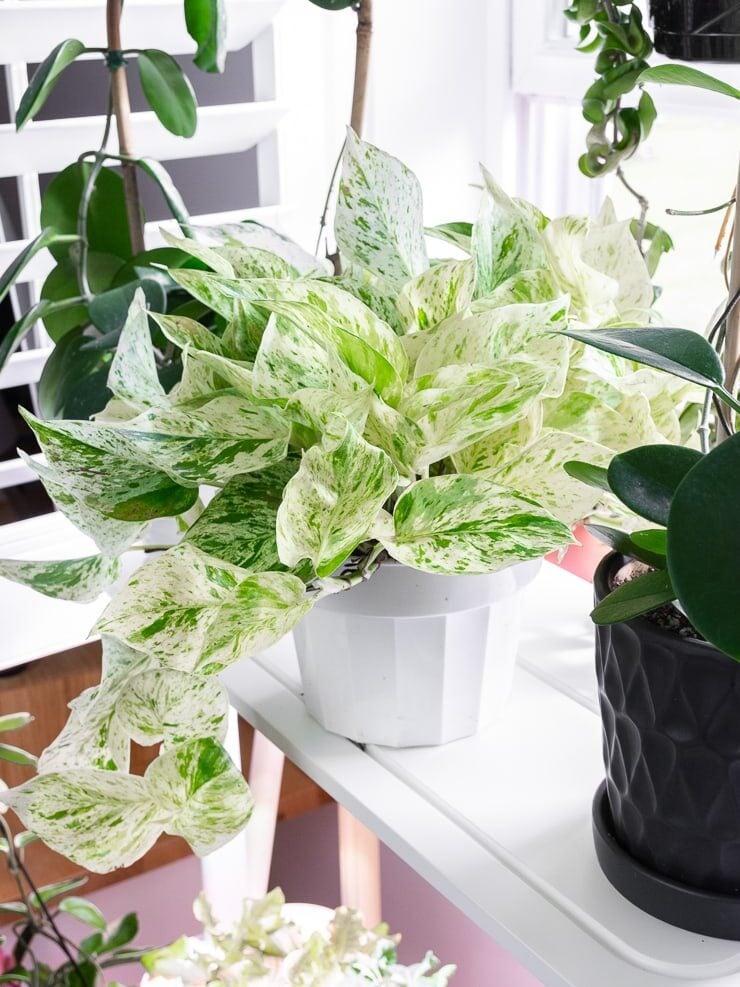
The thing that makes snow queen pothos unique and a bit more interesting than some other pothos plants, though, is its gorgeous variegation. The leaves are generally very light—nearly white—with green variegation and speckles on them.
You might think, “Brittany, you’re talking about a marble queen pothos.” And I could be, because the marble queen pothos plant is very similar to the snow queen pothos plant. And man, is it confusing! So let’s have a nosy at them.
Snow queen vs. marble queen
Now, whether or not there is actually a difference between snow queen and marble queen pothos is the million dollar question. I have gone down many rabbit holes trying to find conclusive evidence that they are the same or different plants. And all I’ve found is lots of opinions.
I don’t count some random person on a Reddit thread saying “yes, I’m certain snow queen and marble queen pothos are the same plant” as a conclusive source. I love sources! But unfortunately there is a lot of gray area in the houseplant cultivar world.
Originally I learned that snow queen and marble queen were different plants that just looked very similar. The marble queen pothos was said to have green and pale yellow marbled, striped, or speckled variegation. A snow queen, however, had more white (less yellow) variegation. Sometimes pure white with specks of green.
And I was satisfied with that distinction…until last year. I moved the plant I’d purchased as a “snow queen” into a lower light area when we moved to our current home. After two years, well, it looked an awful lot like my marble queen. So that led me to do some more digging.
I learned that ‘marble queen’ is actually not a patented variety of pothos (this patent mentions that marble queen is not patented). I assume the marble queen cultivar is a spontaneously developed cultivar. And the current popular opinion seems to be that snow queen is actually just a highly variegated marble queen.
And I’m inclined to agree after moving my snow queen to lower light and watching it develop into what clearly looks like a marble queen over a few years. So, if you’re reading this and have any definitive information on the differences (or similarities) between marble queen and snow queen, I’d love to hear from you!

Light
Bright, indirect light is best, and the plant will also grow well in medium light levels. It just depends on what you want your variegation to look like, and how fast you want the plant to grow. If you want the whitest leaves possible, the most striking variegation, and optimal growth rates, shoot for bright, indirect light.
That’s because the variegation in the leaves is a result of having less chlorophyll. That’s right—the white parts of the snow queen’s leaves do not contain chlorophyll, and chlorophyll is the magic sauce in the leaves that help the plant absorb energy from light sources to undergo photosynthesis.
And that means that the leaves have less surface area to take in light and grow, meaning that you definitely want to maximize the light the plant gets. When I had mine in a south-facing window, it was highly nearly white variegation.
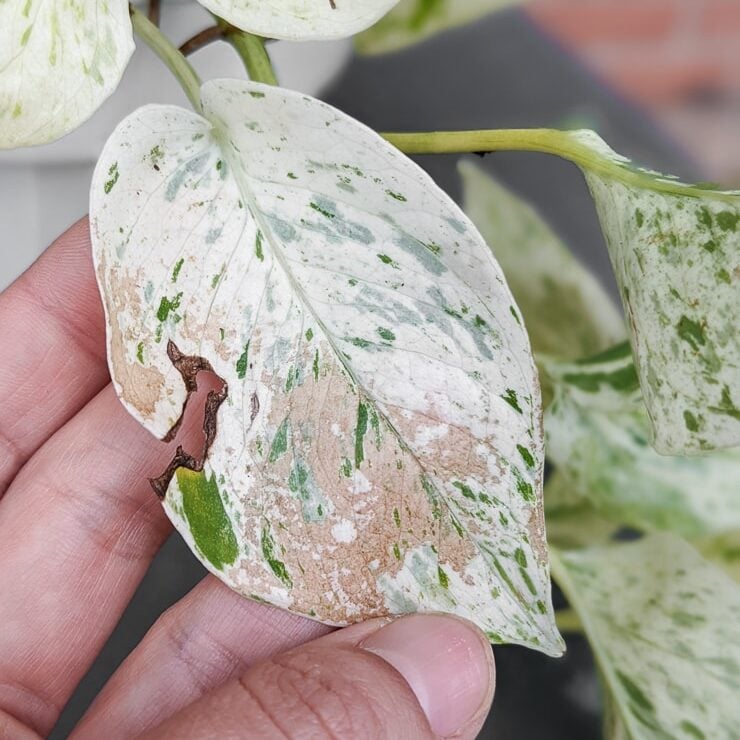
Remember that too much direct sunlight can burn the leaves, though. Some direct morning sun is probably fine since that sun is weaker. However, keep an eye on the plant for signs of distress if you have concerns about the plant’s placement. Below is an example of a scorched leaf that occurred when I moved my snow queen out onto my east-facing covered porch.
But maybe you don’t have a spot with bright, indirect light, don’t care much about the variegation, and are fine with it fading from a bright white to more of a cream or yellow. If so, I can tell you that’s exactly what my snow queen has done in medium light levels! It still grows well, though, and is a perfectly healthy plant.
Water & soil
I plant all of my pothos plants in a well-draining houseplant soil mix. These plants are not terribly picky as long as their soil is well-draining. Occasionally I’ll throw in an extra handful of perlite or coco coir when repotting. Perlite helps facilitate drainage, while coco coir is a great alternative to peat moss that retains moisture without keeping the soil too wet.
Keeping the soil too wet is a sure-fire way to kill a pothos. They are susceptible to root rot and do not like their roots sitting in water. I water my pothos plants only after the soil has almost entirely dried out.
You can usually safely water your pothos plant after the top several inches of soil dry out, but I like to err on the side of potentially underwatering. That’s because they tend to withstand neglect well and bounce back quickly if I push them too far without water, while they are not as forgiving of overwatering.
If your snow queen pothos gets a lot of light, it will probably dry out faster and need more water. That’s why it’s always best to check your soil for clues instead of keeping a strict schedule. (Though you’ll definitely get into a rhythm once you settle your plant into its new home.)
When I water my pothos plants, I also like to water them deeply in the sink, shower, or outside in the spring and summer. This means that I thoroughly soak the soil, letting all of the excess water drain out of the drainage holes.
While I am doing this, I also rinse off all of the foliage as best I can. Including the undersides of the leaves. This helps keep the leaves clean and dust-free. It’s also a great best practice for pest prevention.

Temperature & humidity
Snow queen will benefit from some extra humidity, which will help prevent the super white parts of the leaves from browning. Extra humidity along with great light and warm temperatures work together to keep those leaves white. If you notice browning, crispy spots on the leaves—especially the white parts—consider your humidity levels.
That said, this plant generally does well in all household humidity levels. It is a patient pothos, after all. Just monitor it for any issues and adjust as necessary.
It also does well in a variety of normal household temperatures. Between 60 and 85 degrees Fahrenheit is best. As a tropical plant, though, it is not cold or frost hardy at all and will die if temperatures are consistently below 50 degrees.
I like to take some of my pothos plants outdoors for the spring and summer so they can soak up the warm, humid Maryland weather. But they need to come back inside in the fall—at least where I live.

Growth & repotting
As a variegated plant, snow queen pothos is generally a slower grower—at least when compared to some of its relatives, which grow like absolute weeds. (And in some cases grow so prolifically that they have become invasive, like some areas in Florida.)
Plenty of bright indirect light will help speed up this plant’s growth. If you have it in medium or lower light levels, its growth rate will definitely slow down.
Boosting humidity levels will also help the snow queen’s growth, especially as it relates to leaf size. I am always astounded by how large my pothos plant leaves get when I have them outside in our super humid summers! It always makes me a little sad when I have to bring my plants inside for their long, sad winter.
I recommend repotting your snow queen pothos every few years and sizing up only an inch or two when you do. I usually wait until the roots begin growing out of the pot’s bottom to repot. When you do repot your snow queen, make sure to use fresh soil to replenish its nutrients.

Want more? Check out my guides for Baltic Blue Pothos Care and Cebu Blue Pothos Care!
Fertilizer
Pothos plants generally do not need to be fertilized as long as you use a high-quality soil that has nutrients in it. However, nutrients deplete over time. So if you haven’t repotted your pothos plant in a while, fertilizer can be helpful.
I recommend using something like organic worm castings that you can work into the top layer of soil. When you water the plant, the nutrients will disperse throughout the plant’s root system.
I’ve also started using Liqui-Dirt (affiliate link) roughly every three or four times I water my houseplants, too. I like using this highly concentrated fertilizer because I can just pour a bit in my watering can.
It isn’t a chemical fertilizer either, so you don’t have to worry about over-fertilizing your plants and burning them. It’s good stuff, and my plants seem to be really happy with it added to their care routine.

Propagation
Snow queen pothos plants are quite easy to propagate from cuttings. Simply take a cutting of your plant that has roughly 2–3 leaves and 1–2 nodes.
You can take a cutting that has a little bump on the stem where an aerial root would eventually grow, or you can take a cutting and remove the lower-most set of leaves to expose growth points. Then it’s time to prepare your medium.
You can just pop the cutting into water and wait. Refresh the water every week or so, and make sure the growth points are always submerged in water. Once the cutting has roots that are several inches long, you can transplant the cutting to soil. Keep the soil moist as the cutting’s water roots acclimate to soil and transition.

Pest issues
Snow queen pothos plants are not terribly vulnerable to pests. Just the normal houseplant pests you might encounter, and they’ll likely either enter your home on another plant and spread to the snow queen or come as a terrible bonus gift on your new snow queen.
Mealybugs are some of the most common pothos pests. They look like white cotton masses on your plant, most notably where the leaves meet the stems. See my article for more on identifying mealybugs and getting rid of them.
Fungus gnats are another common household pest that are more annoying than they are harmful. They can also signal an overwatering issue in your care routine because they lay eggs in moist soil. To get rid of them, make sure you are letting the top few inches of soil dry out!
I have a piece all about how to get rid of gnats in houseplants, and it also includes what causes them. Check that out for a detailed article on the topic.
Toxicity
Pothos plants in general are considered mildly toxic when ingested, and this includes snow queen pothos. Keep this plant away from both pet and human nibblers.
Pin my guide!


Brittany is a seasoned DIY home and garden expert, running a creative brand since 2014 that inspires others with approachable plant care guides, sustainable gardening how-tos, and DIY projects. She is a master gardener and certified project manager who has completed extensive coursework in the art and science of growing your own plants. Her favorite thing to do is inspire you! Learn more about her here.
Leave a comment